Stealing cars in GTA 6: tools, the WAINK app and fences
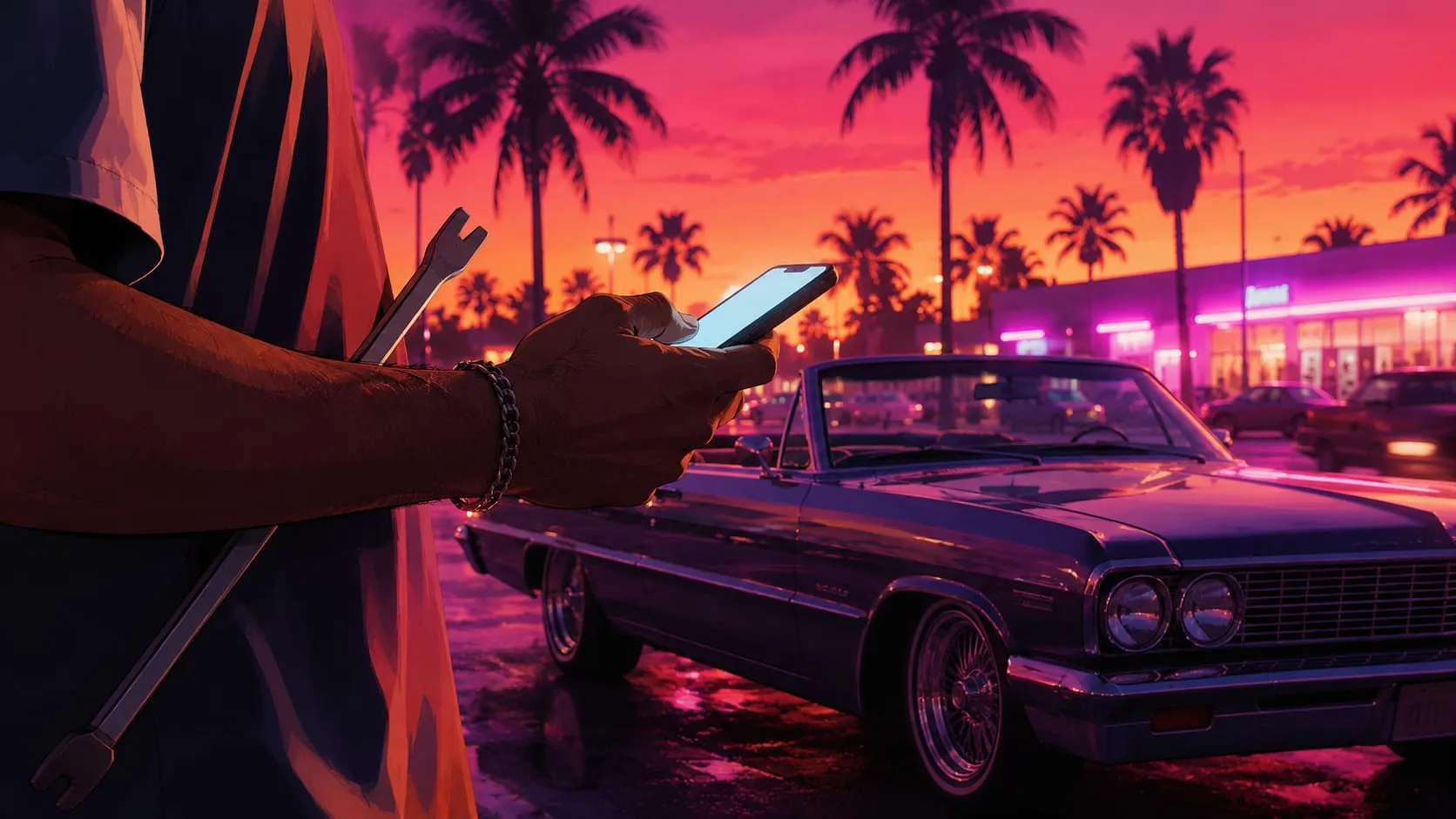
The act that gives the series its name has always been the simplest one: break a window, get in, drive off. In GTA 6 that act becomes a system, and the stated reason is that real cars have not been stolen that way for twenty years.
The person describing it is Rob Nelson, co-studio head of Rockstar North, in a preview given to IGN: you used to press a button to steal any vehicle, and that system, he says, left a lot of potential on the table in terms of progression and choices.
A note on the line you will see quoted everywhere, “you won’t be able to magically hotwire every car”: that is not a Rockstar statement, it is the headline GamesRadar used to summarise those words. The distinction matters, and through the rest of this guide we keep who said what apart.
The game launches on November 19, so nothing here has been tested: this is the system as described by the people building it, to the people who were in the room.
Before you approach: the app that scans the car
The most unexpected addition is not a burglary tool, it is a phone app. IGN calls it a scanning app and reports that both protagonists have it; the name WAINK appears in the write-ups, not on an official page. It lets you examine a parked car before you walk up to it, and not necessarily every car: the whole point of the previews is that not every parked vehicle is within reach.
What it tells you, according to the previews:
- whether the car is locked
- whether it has an alarm, and what kind
- whether it carries a tracker
- what it is worth if you take it to a Pay ‘n’ Spray or a specialist fence
- what it costs to register as your own personal vehicle
Put another way: theft stops being an impulse and becomes a decision. You look at the price, you look at the risk, and you decide whether that car is worth the trouble.
The tools, and which cars need them
One simplification goes first, because it is everywhere: that the system has two tiers, old cars and modern ones. IGN writes explicitly that it does not know how many security tiers exist. What is known is that there are at least two tools, and that they do different things.
The slim jim is about getting in. It is the flat strip slid between glass and door frame, the same thing roadside assistance uses when you lock yourself out, and in game it becomes a stick minigame: not automatic, not instant. That it is reserved for older models comes from a single outlet, and hedged at that.
The key cloner is about starting the car, not opening the door. This is the part summaries most often invert. Nelson puts it the other way round: you can break the window and get in, but without a cloner certain cars will not start. How it works technically in game is not described by any first-hand source, so we do not explain it: the accounts about intercepting and rebroadcasting the key’s signal are added downstream, and in the real world cloning a key and running a relay attack are two different techniques.
Cars with someone at the wheel. Nothing changes here: carjacking works exactly as you remember from previous games. If there is a person inside, the car can be taken.
There is a progression consequence too, and it is the part that most resembles a role-playing game: some cars are out of reach early on, because the tool you need arrives later in the story. Seeing a supercar parked and being unable to touch it is a new situation for the series.
Trackers, and why speed matters
The more expensive vehicles can carry a tracking system that alerts the police, and the direction of the mechanic needs stating precisely, because it gets inverted everywhere. Speed detaches nothing: the more advanced trackers report your position when you travel below a certain speed, so driving fast keeps you from being reported rather than outrunning a signal. To actually remove one, per Rob Nelson, a fence capable of stripping trackers appears at some point in the story.
It is a detail that inverts the usual instinct. After a theft the natural reaction is to drive slowly so as not to attract attention; here, on certain cars, driving slowly is precisely how you get caught.
There is a flip side for cars you own: if you abandon a vehicle registered in your name after committing a crime, it gets impounded. The nice car becomes a liability the moment things go wrong.
After the theft: the tank, the colour, how many cars you can keep
Almost all of this section comes from one source, MikeShowSha’s account, from the July session at Rockstar North. Read it for what it is: first-hand detail about a July build, not something Rockstar has confirmed.
Cars have fuel. Rob Nelson confirmed it to him out loud: you refuel, and electric cars recharge at charging points. A full tank lasts a long time, so it is not designed as a constant tax that stops you every ten minutes.
The detail that matters to a thief is a different one, and it changes the arithmetic: a stolen car often starts with less fuel than one of yours, because you get whatever was in it. The getaway car can carry a range you did not choose.
Respraying matters, and it is not the same as a fence. In his session, to break away from the police, they abandoned the electric car (which carried a GPS tracker) and took the new one to a mechanic for a colour change. Here too the testimony lines up with Famitsu’s, where Nelson describes the Pay ‘n’ Spray as the place you repair and respray a vehicle to shed heat, with the service stopping at the colour change. It is consistent with the general rule: the vehicle is a line in the description, and changing how it looks removes that line.
Registered vehicles have a cap, and here two independent sources agree. In the July build there were three slots: Jason’s car, Lucia’s, and a third. To register the car they had just stolen they had to sell Jason’s.
The same number, with the same mechanism, comes from Rob Nelson in the interview Famitsu published on August 28, 2026: at the start of the game there are places for three cars only, with the places full you have to sell one to register another, and buying garages around the map lets you own more. Two different people, in two different rooms, reporting the same figure: that is the kind of convergence that counts as verification. The full chapter on garages and ownership is in our vehicles guide.
What a registered car is for, beyond owning it: it is the one delivered to you when you call it from your phone, and it is where your customised weapons live. One touch that says a lot about the game’s care: an NPC brings the car, gets out, hops on an electric scooter and rides off.
The method feeds the Criminal Profile too. Stealing a car in itself moves nothing, because you are a criminal and the game takes that as read. What gets recorded is how: a clean entry with the right tools is one thing, smashing a window in the middle of the street is another.
Selling: fences, and why bodywork matters
Stolen goods have to be moved, and GTA 6 takes the fence idea from Red Dead Redemption 2 with one addition: they are specialised. There are fences for jewellery and fences for cars.
The car fence does not only buy: they can also give you information. The previews cite a concrete example, the code to get into a police impound lot with vehicles to steal and resell. Roundups often turn this into “an informant with access to the impound”: at source there is no informant, it is the fence passing the information along, and nobody says the vehicles held there are high-value.
And then there is the rule that changes how you drive: a damaged car is worth less. Delivering one intact is harder than in previous games, because Vice City’s streets are narrower and the traffic heavier, both deliberate choices in service of realism. Getting a car home without a scratch becomes a small challenge in itself.
The money picture around it
Stealing cars is not a pastime: in GTA 6 money plays a bigger role in the story, and at certain points you need to reach a certain amount for the main missions to continue.
There are four main ways to make it: stealing and selling cars, robbing businesses, shoplifting, and bank robbery. Car theft is the one you can do at any moment, with no preparation.
Two things worth knowing about money, because they change behaviour. First: what you carry is lost if you die or get arrested, while what is in the bank stays, so it pays to deposit before taking a risk. Second, and worth saying because plenty of people ask: single-player money cannot be bought with real currency.
What we still do not know
The things this guide cannot tell you, because nobody has established them.
How many vehicle tiers there actually are, and how they are divided. What cars are worth and what registering one costs: no figures have been published. Below what speed a tracker reports your position, and at what point in the story the fence who removes them appears. Whether the Pay ‘n’ Spray still clears a wanted level as in the old games, or only handles resale. How many fences there are and whether they keep hours or territories. How fast a tank actually drains, and whether running dry has a real consequence or is just a nuisance.
On the cap for vehicles you can keep, though, the point is as closed as it can be before release: three places at the start of the game, said by Rob Nelson to Famitsu and found again in an independent hands-off session. What remains unknown is how many garages you can buy and what they cost.
And a note on method: the proper names, WAINK included, come from preview transcriptions rather than an official page. They need rechecking on screen at launch.
In short
- Cars are split into tiers: the more modern and expensive, the more tools and skill they take.
- A slim jim with a stick minigame for old cars, a key cloner for anything with an electronic key.
- Carjacking a car with someone at the wheel works as it did in previous games.
- A phone scanning app examines a vehicle before you approach: locked, alarm, tracker, resale value, registration cost. The name WAINK comes from preview write-ups, not from Rockstar.
- Some cars are inaccessible early on, because the tool arrives later in the story.
- Speed does not detach a tracker: the advanced ones report your position when you travel below a certain speed, so driving fast keeps you from being reported.
- Fences are specialised, and they pay less for a damaged car.
- Cars have fuel and electric ones recharge: confirmed out loud by Rob Nelson to a creator at the session, but the gauge is not visible in the official video.
- A stolen car often starts with less fuel than one of your own.
- There are three places for registered vehicles at the start of the game, and registering a new one means selling another: Rob Nelson says so to Famitsu, and an independent session confirms it.
- The Criminal Profile does not read the theft itself but the method: tools and a clean job against a smashed window.
Frequently asked questions
How do you steal cars in GTA 6?
It depends on the car, but not in the simplified way you will read elsewhere. The slim jim gets you in, through a stick minigame; the key cloner is what starts the vehicles that will not start without it. How many security tiers exist is not known: IGN, which attended the session, writes that it does not know. Any car with a person at the wheel can still be taken with a classic carjacking.
What is the WAINK app in GTA 6?
A phone app, described by IGN as a scanning app, that lets you examine a parked car before you approach it: whether it is locked, whether it has an alarm or a tracker, what it is worth if you sell it, and what it costs to register it as your own. The name WAINK appears in preview write-ups, not on an official Rockstar page.
Can you steal every car from the start?
No. Some vehicles stay out of reach in the early game because the tool you need is acquired later in the story.
How do you remove a tracker from a stolen car?
Not with speed: speed detaches nothing. The more advanced trackers report your position to the police when you travel below a certain threshold, so driving fast keeps you from being reported while you drive. To actually remove one, per Rob Nelson, a fence who handles it appears at some point in the story.
Should you deliver a damaged car to a fence?
No: a damaged car is worth less. Getting one there intact is harder than before, because Vice City’s streets are narrower and busier.
Do you have to refuel in GTA 6?
Per what Rob Nelson told a creator at the July session, yes: cars have fuel and electric ones recharge at charging points, but a full tank lasts a long time, so it is not designed as a constant chore. One caveat, though: the gauge does not appear in the official Extended Look, so it stays reported rather than confirmed.
How many cars can you keep in GTA 6?
Three at the start of the game, and with the places full you have to sell one to register another. Rob Nelson says so in the Famitsu interview of August 28, 2026, and a creator at the July session found the same thing. Buying garages around the map lets you own more, but how many and at what price nobody says.
Are there microtransactions in GTA 6 single-player money?
No. Money in the single-player campaign cannot be bought with real currency.