GTA 6 on PS5, PS5 Pro, Series X and Series S: Digital Foundry's analysis
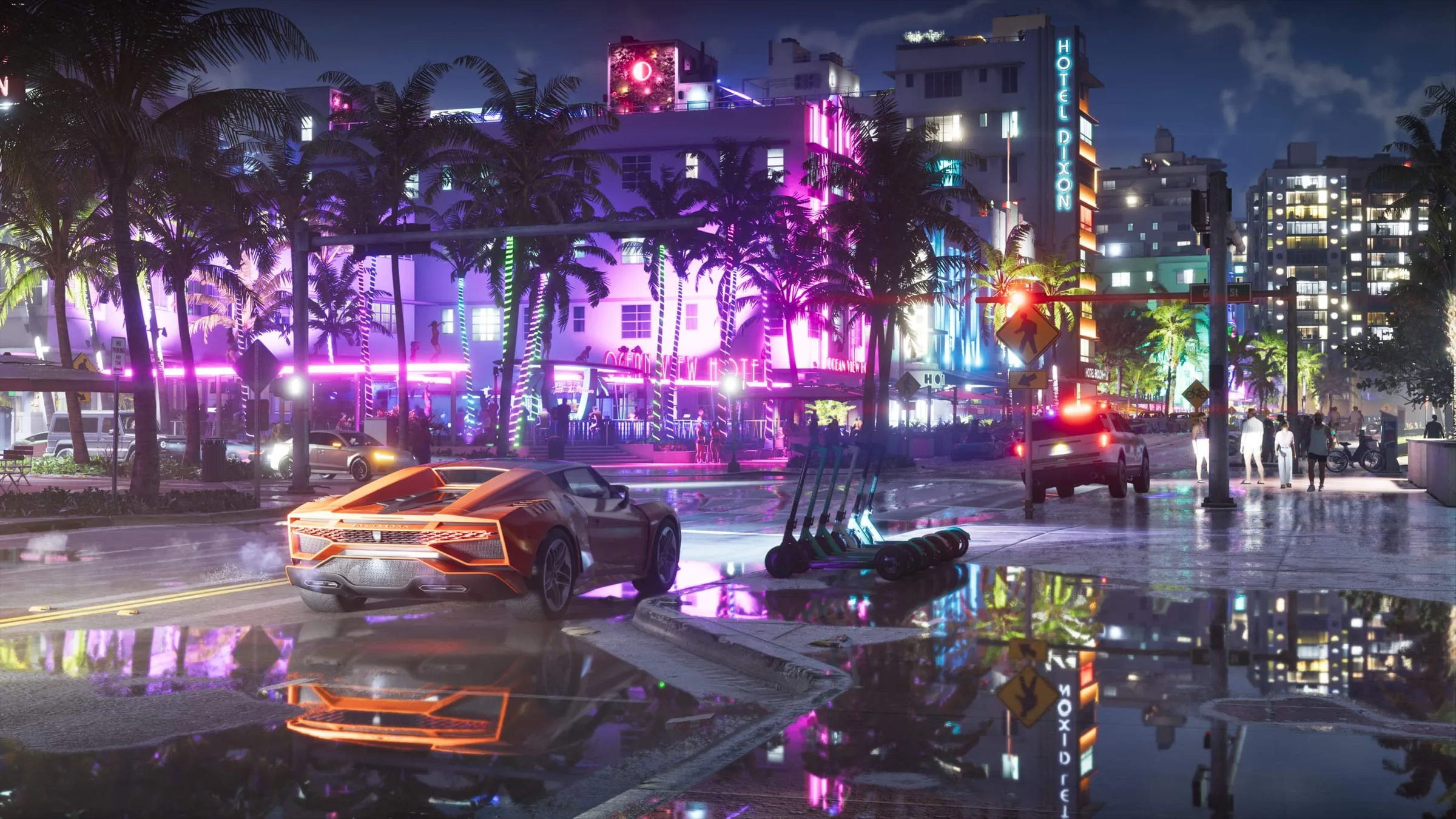
On November 18 Digital Foundry published the first full analysis of GTA 6 on all four consoles: PS5, PS5 Pro, Xbox Series X and Xbox Series S. The same day Wccftech published the official resolutions and upscalers for each version, in a technical statement from Rockstar, and Kotaku reported that Rockstar ruled out a 40 or 60 fps mode. Together they close the question opened on November 10 by our story on 30 fps across every console: we now know how well that 30 fps actually holds and what changes from one console to the next.
The short answer: PS5 Pro is the best version, PS5 and Series X sit very close to each other and play well, and Series S is the one Digital Foundry finds hardest to recommend. The rest of this piece explains why, and what to expect on the console you own.
The four versions side by side
| Console | Internal resolution | Output and upscaler | Ray tracing | Frame rate (DF measurements) |
|---|---|---|---|---|
| PS5 | 1440p | 4K, spatial upscale with Rockstar’s TAA | Global illumination and reflections | 30, dipping into the high 20s; low 20s at worst |
| PS5 Pro | 1440p | 4K with PSSR | Global illumination, reflections and shadows | Near-locked 30; 24 minimum in the heaviest test |
| Xbox Series X | 1440p | 4K, spatial upscale with Rockstar’s TAA | Global illumination and reflections | Same as PS5 |
| Xbox Series S | 720p | Around 1080p with AMD FSR 4 | Global illumination and reflections, scaled back | Often 25 to 30; around 20 at worst, sometimes lower |
The figures come from over 100 hours of testing across the four versions, split between John Linneman, who played on PS5 and PS5 Pro, and Oliver Mackenzie, who played on Series X and Series S. On the three stronger consoles DF saw no immediate signs of dynamic resolution scaling.
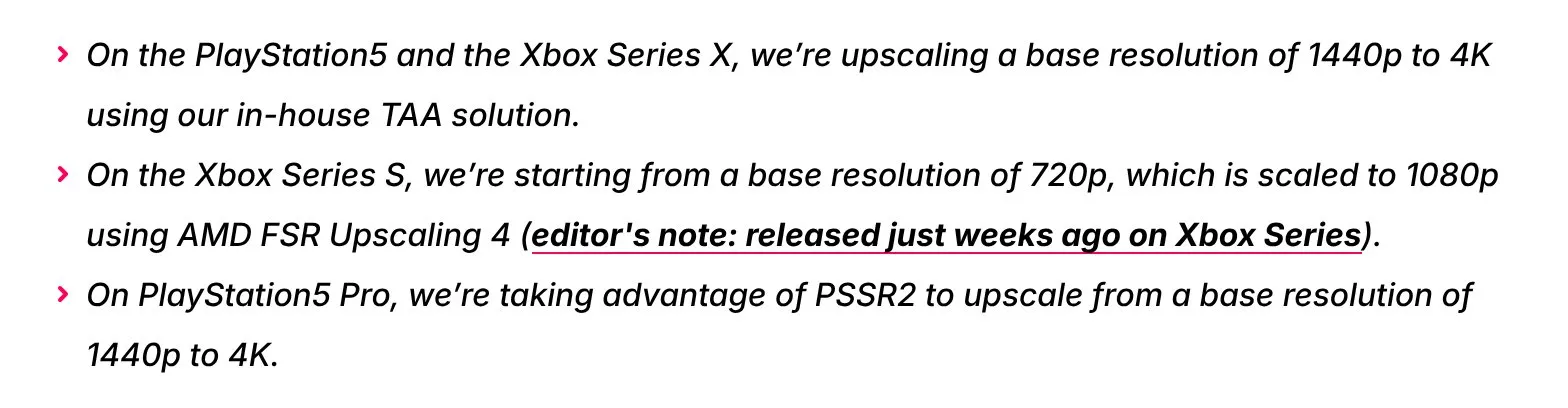
The bold note in brackets comes from Wccftech’s editors, not Rockstar: FSR 4 had reached Xbox Series consoles only a few weeks before launch. From Wccftech, November 18, 2026.
One difference the table undersells: on PS5 and Series X the 1440p image gets a spatial upscale, not a reconstruction through a temporal upscaler such as Sony’s QSSR or AMD’s FSR. The result, DF writes, is a visibly softer image. Linneman calls the base PS5 image “noticeably softer”, with fine distant detail resolved less clearly. On the Pro, PSSR reconstructs a clean image that “convincingly mimics native 4K”.
How well the 30 fps really holds
Every version targets 30 fps and nothing else: “There’s no option for a 40fps or 60fps mode on any platform”, Digital Foundry writes. There is no choice between quality and performance modes.
PS5 Pro is the most stable. Across around 75 hours of standard play DF recorded a consistent 30 fps; the only real drop, to a minimum of 24 fps, comes when destroying multiple vehicles with the grenade launcher, and the frame rate recovers quickly. Linneman describes an unwavering 30 fps lock “with perfect frame pacing”, meaning frames are delivered at even intervals.
PS5 and Series X share the same target but hold it “a little more loosely”: during fast traversal, combat and the heavier scenes the frame rate often flicks between 30 and the high 20s. In the same exploding-vehicles test the drops persist until you leave the area, and at worst the game falls into the low 20s. In the video, as quoted by VGC, Linneman admits the PS5 “does struggle to hold 30fps more often than expected”, but adds that in normal play the dips are “really very minor”, even if he noticed them. Mackenzie, also via VGC, says that on Series X the game “does a reasonable job of hitting and holding 30fps during typical play”. The 23 fps figure repeated by some outlets comes from the frame-rate counter in DF’s PS5 video, during the exploding-vehicles test: the article does not quote it and speaks in ranges, but it is consistent with the low 20s.
There is good news too. RAGE, Rockstar’s engine, has long carried a flaw: animations updating at an uneven rate, visible in pre-release footage and in DF’s early Xbox testing. According to DF, patches released before launch appear to have fixed it, and animations now play out with consistent pacing.
Why no 60 fps, not even on PS5 Pro
After November 10, the question on many minds was whether a performance mode could arrive later in an update. Kotaku had put it to Rockstar before the 30 fps announcement, and published the answer on November 18.
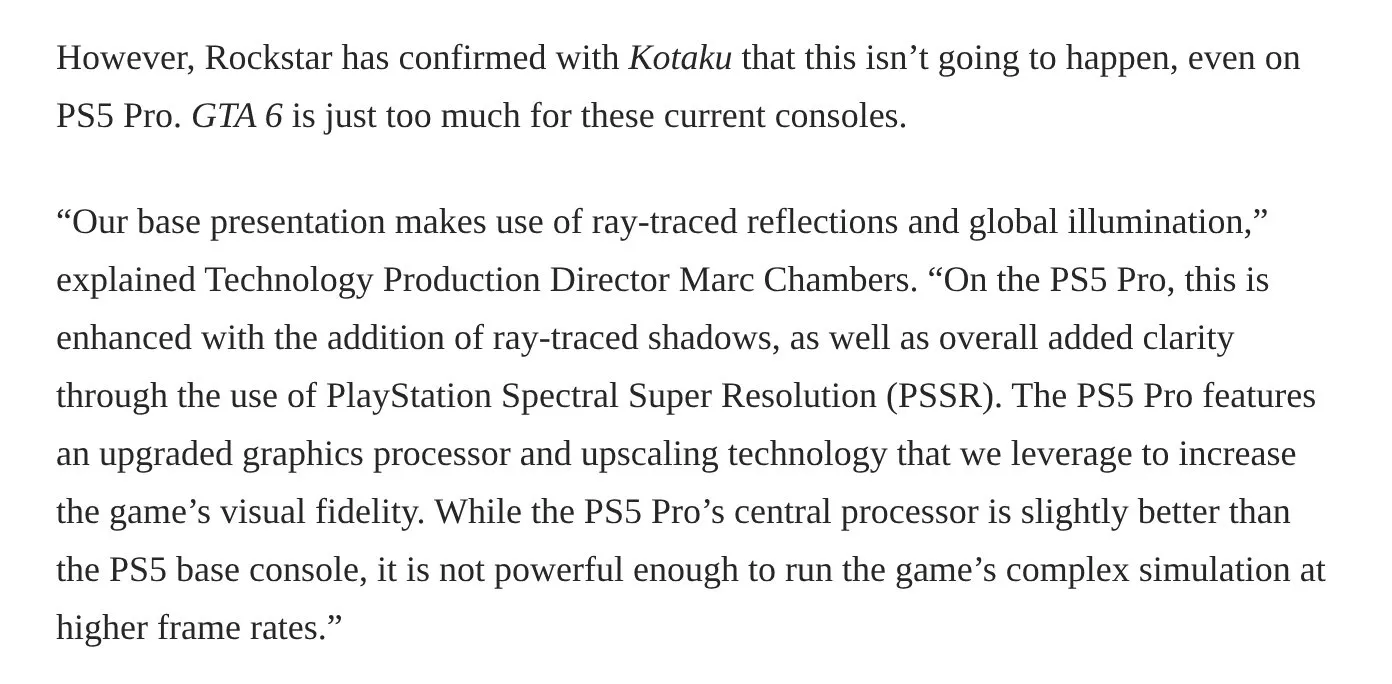
The first line is Kotaku’s, not Rockstar’s: the quotation marks only open with Chambers’ words. From Kotaku, November 18, 2026.
In the Wccftech statement Rockstar tells the same story from the other side: it became clear early on that, given the scale of the project’s ambition, the target on this hardware generation would be 30 fps. DF adds a concrete technical reason: strand-based hair with physics runs on every character, bystanders included, while most games keep this expensive tech for the protagonists. It is one more reason, Linneman writes, why a 60 fps mode was not feasible on current consoles.
Rockstar has announced nothing for PC. Kotaku expects a port with higher frame rates, but that is the site’s prediction: where things stand is in our story on GTA 6 on PC.
Ray tracing: what every version gets and what only the Pro gets
This is where the surprise is a pleasant one. All four versions, Series S included, use ray-traced global illumination and ray-traced reflections, the latter in a hybrid approach with screen-space reflections layered in. Rockstar tells Wccftech it wanted the same lighting solution on every console, Series S too, where memory pressure “posed a bit of a challenge”, rebalancing the global illumination per console.
Only PS5 Pro adds ray-traced shadows: natural transitions between light and shadow and pin-sharp contact shadows. The other consoles use traditional shadow maps, which DF still rates as high resolution with variable penumbra.
Linneman’s verdict is clear: GTA 6 is a technical landmark of this generation, and its ray tracing is “arguably the best implementation of ray tracing we’ve seen to date”, with very few of the artefacts typical of other engines. DF also notes:
- draw distance: level-of-detail transitions in the distance are imperceptible, with traffic, pedestrians and street lamps active right up to the horizon;
- sky and weather: a physically based sky and volumetric clouds evolved from Red Dead Redemption 2, with storms forming over individual districts;
- HDR: specular highlights beyond 1500 nits; Rockstar tells Wccftech it built the lighting and image pipeline with both HDR and SDR in mind from the outset;
- flaws: some denoiser noise and visible screen-space reflection layering on rough metallic surfaces, such as elevator doors.
Xbox Series S: the hardest version to recommend
The Series S is the most interesting case, because it has to carry the same world with less memory and a cut-down GPU. According to DF it does better than expected visually, and worse on frame rate.
| What stays as on PS5 and Series X | What gets cut |
|---|---|
| Ray-traced global illumination and reflections | Lower-precision lighting, softer and lower-resolution reflections |
| Strand-based hair on every character | Lower-resolution hair and facial hair |
| Leonida’s scale and scope, thanks to the same CPU and SSD as its bigger siblings | More pop-in at high speed |
| Lower-resolution shadow maps and some missing self-shadows in cutscenes | |
| Muddier textures at oblique angles, lower-resolution volumetric clouds and depth of field, flatter water |
The upscaler is AMD FSR 4: according to DF, this is the first shipping game on Series consoles to use it. The problem is smoothness. Large portions of the game run between the mid and high 20s, dense combat stays in the mid-20s for its whole duration, and destroying vehicles drags the game to around 20, with DF’s caption even mentioning the teens with a grenade launcher. DF calls it “a 25-30fps no-man’s-land”. Mackenzie, quoted by VGC, advises playing on another console, and hopes to see improvements over time.
The same applies to streaming: according to Rockstar’s Newswire, anyone playing on Xbox One through Xbox Cloud Gaming gets the Series S graphics settings. Details and costs are in our Xbox Cloud Gaming story.
120Hz, VRR and input lag: what the datamine got right
After the pre-load a dataminer wrote about a 120Hz mode without VRR in the files, as covered in our pre-load datamine story. DF’s testing settles it: DF describes no 120Hz mode in the game, and the only 120Hz it talks about is a system-level feature of Xbox consoles, with VRR enabled at that.
- Xbox: at the system level the console can run the game inside a 120Hz signal with VRR enabled, which DF describes as “a slightly smoother experience”.
- PS5 and PS5 Pro: no 120Hz option for the game. You can force system VRR on, but it only works above 48 fps and without low frame rate compensation: in a 30 fps game, DF writes, “this does nothing”.
On input lag, DF measured around 180 milliseconds of end-to-end camera movement latency on Series X, including a wireless controller and around 10 ms of display latency. The figure does not change substantially across 60Hz, 120Hz and 120Hz with VRR. It is similar to Red Dead Redemption 2 and GTA 5 Enhanced, although response feels a little better in GTA 6. Rockstar told Wccftech that input latency is “vastly improved” over GTA 5 and Red Dead Redemption 2: DF’s numbers point to something more modest, similar figures with a slightly more responsive feel.
In practice: on Xbox, if your TV supports 120Hz and VRR, it is worth keeping both enabled in the console’s video settings. On PS5 there is nothing to gain, and a TV in game mode matters more, as our TV and console settings guide explains.
The few settings in the menu
GTA 6 has very few graphics options. The one that matters is motion blur, set to 3 out of 10 by default: raising it makes motion look smoother, lowering it gives a sharper image. In the menu, it is the only real lever for tuning 30 fps to your taste. Depth of field and vignetting, the darkening at the edges of the screen, cannot be adjusted.
On vignetting, Wccftech got an answer from Michael Kane, Rockstar’s Vice President of Dynamic Art: it is “an artistic choice”, there is no toggle to remove it at launch, but the studio identified and fixed an issue that made it stronger than intended in certain circumstances. Kane does not say whether the fix is already in the launch version or will arrive in an update.
Why no FSR 4 on Series X and no QSSR on PS5
The question came up immediately: if Series S uses FSR 4, why doesn’t Series X? And why doesn’t the base PS5 use QSSR, Sony’s new upscaler for the standard console?
What about FSR 4.1? Microsoft has already made it available to developers on Xbox Series consoles, but it is not a system update that improves games on its own: as Digital Foundry explains, each game has to integrate it. As VGC notes, there is no indication that Rockstar will adopt it on Series X as well.
Which console makes sense
| If you own | What to expect | Our advice |
|---|---|---|
| PS5 Pro | The best version: near-4K image, ray-traced shadows, 30 fps held almost all the time | Nothing to do: the standard TV and console settings apply |
| PS5 | A softer image, some dips under 30 in heavy scenes | Play with confidence: for DF the game “looks and plays well” |
| Xbox Series X | Like PS5, with the small bonus of system-level 120Hz with VRR | If your TV allows it, enable 120Hz and VRR |
| Xbox Series S | The full world, but often 25 to 30 fps at around 1080p | If you have another console available, DF suggests using that |
| Xbox One (cloud) | Series S graphics, streamed | Connection quality matters most |
A caveat on the PS5 versus Series X comparison: Rockstar only showed the Xbox versions publicly once the game went live in New Zealand, and DF’s two analysts played on different platforms. DF itself warns that nailing down every change is hard and promises more direct comparisons in future content. If you already own one of the two consoles, nothing in these measurements justifies switching.
To see the differences in motion, Digital Foundry’s channel has both video analyses: the tech review on PS5 and PS5 Pro and the Xbox Series X and Series S versions. For what the critics thought, see our GTA 6 reviews story.
Summary
- PS5, PS5 Pro and Series X start at 1440p and output 4K; Series S starts at 720p and outputs around 1080p with FSR 4.
- PS5 Pro uses PSSR and adds ray-traced shadows; PS5 and Series X use Rockstar’s TAA, with a softer image.
- Every version has ray-traced global illumination and reflections, Series S included.
- 30 fps is near-locked on PS5 Pro, a little looser on PS5 and Series X, often between 25 and 30 on Series S.
- According to Kotaku, Rockstar confirmed that no 40 or 60 fps mode is coming this generation: for Marc Chambers, the Pro’s CPU is not enough for the simulation.
- There is no 120Hz mode in the game; on Xbox the console can use 120Hz with VRR, on PS5 VRR does nothing at 30 fps.
Frequently asked questions
Does GTA 6 have a 60 fps mode?
No, on any console. Every version targets 30 fps and, according to Kotaku, Rockstar confirmed that a 40 or 60 fps mode will not come even on PS5 Pro, at least this generation: for Marc Chambers, the Pro’s processor is not powerful enough to run the simulation at higher frame rates.
Which is the best version of GTA 6?
The PS5 Pro version, according to Digital Foundry: a PSSR-reconstructed image that looks like native 4K, exclusive ray-traced shadows and a 30 fps that holds almost all the time. PS5 and Series X come right after, with a softer image and a few more dips.
What resolution does GTA 6 run at on PS5?
On PS5 and Xbox Series X the game renders at 1440p and is upscaled to 4K with Rockstar’s own TAA. On PS5 Pro the base is the same, but the upscale to 4K goes through PSSR. On Series S the base is 720p, upscaled to around 1080p with FSR 4.
Does GTA 6 run well on Xbox Series S?
It is playable, with the same world and the same core technologies, but it is the least smooth version: according to Digital Foundry it spends a lot of time between 25 and 30 fps and falls to around 20 in the most chaotic scenes. If you have an alternative, DF suggests using it.
Does GTA 6 support 120Hz?
There is no 120Hz mode in the game. On Xbox, though, the console can use a 120Hz signal with VRR, which makes the experience slightly smoother. PS5 has no equivalent option, and system VRR does not kick in below 48 fps.
Can you turn off motion blur and vignetting?
Motion blur, yes: it sits on a scale up to 10 and defaults to 3. Vignetting and depth of field, no, at least at launch. Rockstar says the vignette is an artistic choice, but it has fixed an issue that made it stronger than intended in some situations.