GTA 6 Extended Look: the analysis, and where each detail comes from
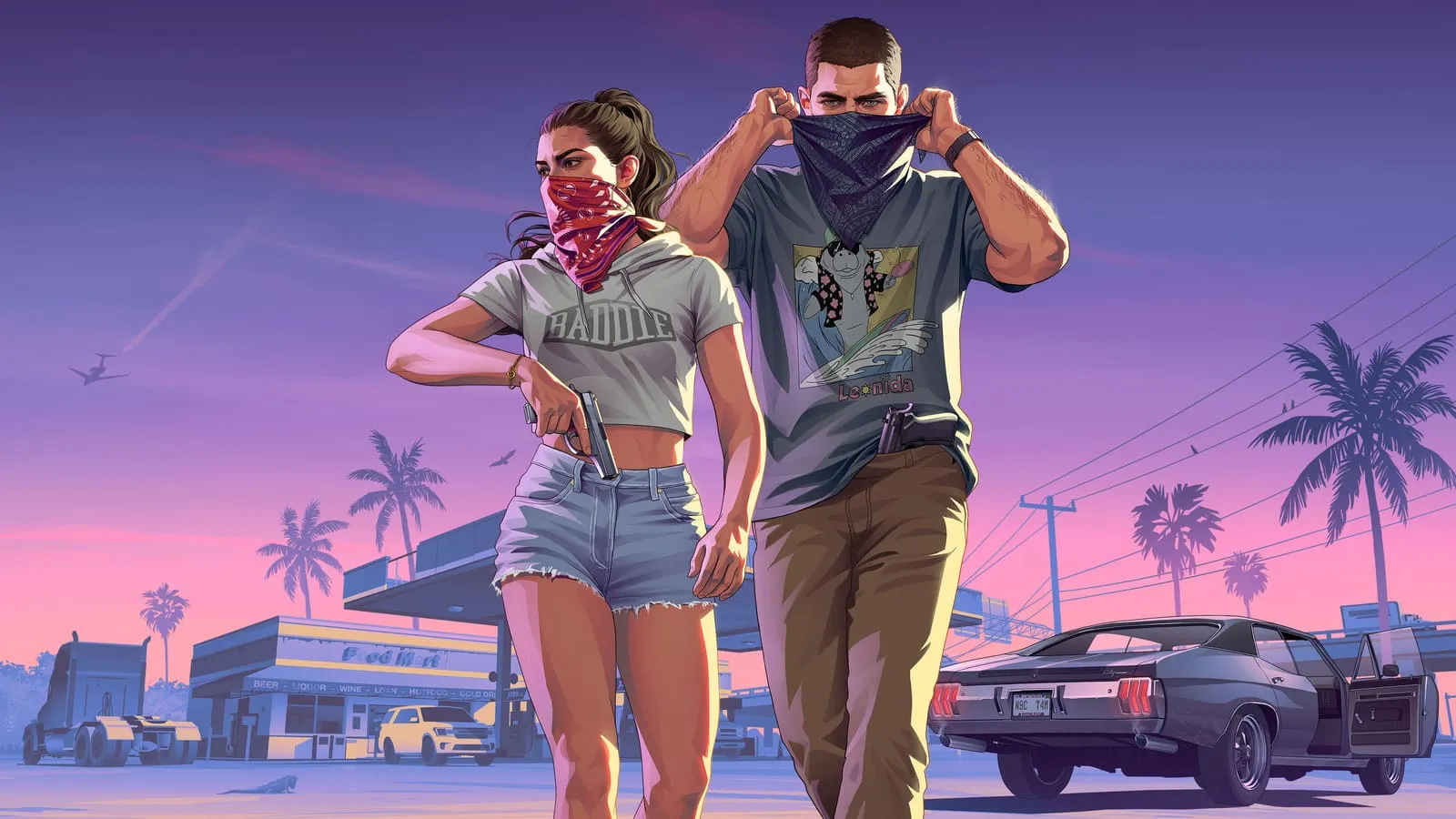
The presentation runs about twenty-seven minutes and has no narrator: no host, no interviews, no captions telling you what you are looking at. It is one continuous montage of play, and it is the longest thing Rockstar has ever shown in this form.
That format has a consequence worth stating up front: the video declares nothing, so every reading of what a scene “means” is interpretation, ours included. But the press previews landed alongside the film, written from a session Rockstar held in July: there the systems are described, not just shown. They are not the same source, and this piece keeps the three levels apart: what the video shows, what Rockstar told the previews, and what comes only from the stolen material.
Scene by scene, with the caveat
Rockstar published no running order and the film has no chapters. The sequence below is reconstructed by cross-checking accounts from people who watched live: the opening and the ending are solid, the order of the middle blocks is not. Outlets presenting it as a settled running order are rounding off.
1. The apartment building. It opens in Vice City, inside a residential block: Jason and Lucia go in, take the elevator, walk the corridors. The job comes from Boobie Ike. That is already a technical statement: lobby, elevator and corridors are interior spaces traversed without loading, and the elevator in particular moves from play to story scene with no visible cut.
2. The apartment. Inside there is a dog to pet, and doing so puts an angel-shaped icon on screen. The deal collapses into a shootout and the police arrive.
3. The escape. First on a motorcycle, then by car: Raul Bautista is picked up off the street, Lucia drives and Jason moves to the back to shoot, helicopters included. The getaway car is burned and the pair switch to a van. The wanted level does not reset.
4. Home. A domestic scene in the pair’s apartment: you open the fridge and choose what to take, the television runs full-screen adverts, you wait while Lucia gets ready.
5. The rooftop party. At Brian Heder’s. Brian asks the two how they ended up in their situation and a flashback to a job gone wrong follows. He then offers work that takes one protagonist, and Lucia takes it.
6. The security detail. A protection job at a corporate opening that turns into a firefight against an armed group, closing with a descent down an elevator shaft.
7. The montage. Activities and open world, containing the showiest character swap in the film: Lucia leaps from a skyscraper, the camera rises, crosses the city and comes down on Jason.
The character swap is the system, not an effect
In the coverage of the Extended Look this is the most repeated and least understood thing. It is not “like GTA 5 but with two instead of three”.
In GTA 5 the three protagonists were three separate lives: you picked who to be and the others left the scene. Here the two are co-present. The character you are not controlling shoots, takes part in robberies, follows you down corridors and takes cover on its own.
And the speed of the switch depends on distance: when the two are close it is instant, even inside the same car, moving from the one driving to the one shooting out of the window; when they are apart the transition takes a few seconds, and in the montage that becomes the camera flying across the city.
There is also the reverse, and it is a structural detail rather than a directorial one: some jobs are for one protagonist only. In the rooftop scene it is Lucia who takes the work. Whether that means character-exclusive missions, or just a choice in that scene, is not established.
The wanted level, and the traces you carry
The most reportable system of the evening is the escape, because it breaks a twenty-year-old habit.
Historically in GTA the wanted level was shed by slipping out of the search cone. Here the getaway car is burned so it cannot be traced, the pair switch vehicles, and the stars stay. Destroying the car stops being something you do for fun and becomes a move that accomplishes something, but not enough.
In a demo shown to an Italian journalist at the Edinburgh studio, and therefore not in the Netflix video, Rob Nelson does the same thing more explicitly: after a robbery he changes clothes, removes a wig and glasses and abandons the car to shake the police more easily. Put another way: the game tracks what you are wearing, what your face looks like and what you drive.
Everyday life is the real technical demonstration
The shootouts make the montage, but the scene that says most about the game is the one at home.
Opening the fridge and choosing what to take. Changing channel with adverts running full screen. Switching off the lights. Picking clothes. Crossing a packed nightclub on foot, shouldering through people. These are things no trailer ever includes, because they are not spectacle, and they only get shown when they genuinely work.
They are worth reading alongside something Rockstar stated on August 26: an entire office, the Los Angeles one, works almost solely on pedestrians. The NPCs in the film have different builds, faces and heights, and coverage agrees this is the most visible leap over GTA 5.
The other practical confirmation concerns the protagonists’ bodies. Nelson said it plainly to Repubblica: the gym is “fully functional”, you can turn the character into “a muscular guy” or stuff him with burgers and “make him very fat”. The San Andreas system is back, and this time it reaches the face too.
Three different sources, and it pays to know which one is talking
This section was rewritten on August 28, and it is worth saying why: the first version got it wrong.
When we published, a few hours after the broadcast, we separated two sources: the presentation on one side, the ten stolen clips on the other. And we listed a set of details as “coming from the leaks, therefore unconfirmed”: the Focus system, the greet and taunt prompts, the wanted-profile icons, the fuel gauge, the tool for opening cars.
The third source was missing. Alongside the video, the press previews dropped, written from a session Rockstar held at Rockstar North in late July: a legitimate source, distinct from the film, where journalists saw and heard the systems described in far more depth than twenty-seven minutes of montage can show. Those previews confirm almost the entire list we had cast doubt on.
With one caveat that changes the weight of every line, and that almost nobody is applying. “The press” was not at that session: IGN, the New York Times and a handful of creators were. Everything else you read, GameSpot, Shacknews, Eurogamer, VGC, Kotaku and the roundups, is a rebound of those two sources. When ten sites write the same thing, that is not convergence between independent outlets: it is one account repeated ten times. Which is why every entry below carries the name of whoever saw it.
One entry on that list, though, does not belong in that box, and we are moving it deliberately.
If you want the whole picture in one screen, here is the table missing everywhere else: the twelve most circulated details, and where each one comes from.
| Detail | Where it comes from | Grade |
|---|---|---|
| Six-star wanted level | The bar is visible in the official video | confirmed |
| Jason and Lucia swap, with the partner fighting | Visible in the official video | confirmed |
| Robberies of small businesses | Visible in the official video | confirmed |
| Petting the dog, and the angel icon | Visible in the official video | confirmed |
| Over 600,000 animations | Aaron Garbut to the New York Times | confirmed |
| Map around three times RDR2’s playable area | Rockstar to the New York Times | confirmed |
| Bodies change with food and training | Stated by Rockstar to Dazed and by Nelson | confirmed |
| The Focus system | IGN, from the closed-doors session | reported |
| The Criminal Profile | IGN, from the closed-doors session | reported |
| The suspect description and its icons | IGN and GamesRadar, with different counts | reported |
| Slim jim, key cloner, scanning app | IGN, from the closed-doors session | reported |
| Around 80 hours for Rob Nelson’s playthrough | Nelson to the New York Times, on a February build | reported |
| Radio station names, the Malibu Club, the metro | Stolen material only | out |
We opened up two of these systems properly, one guide each: how the wanted level works and how stealing cars works.
The lesson from this piece’s first version stands, and it is that caution cuts both ways: treating as unconfirmed something a legitimate source has confirmed is as much an error as the reverse. What we do not do, though, is the next step many took, which is to use the overlap between the systems the previews describe and the ones seen in the stolen material to declare retroactively that the stolen material was reliable. That is not a judgement for us to make: a source that sits outside the scale does not re-enter it because a confirmation arrived elsewhere. It stays out, full stop.
So the distinction has three levels instead of two: what you see in the video, what an outlet that was present described, and what turned up in the stolen material. The first two are citable, by name; the third is not.
What does remain unconfirmed and tied to the stolen material alone: the radio station names, the Malibu Club, Wyman Car Parts, the Vice City metro and the county divisions on the map going round online.
On music nothing changes. Phil Collins is heard in the film, in an elevator scene, and no source gives the track title. The list of radio station names circulating comes entirely from the stolen material, and the thirty-nine-track playlist presented as “by Rockstar Games” is registered to a generic user account and is not confirmed by any official channel.
The only officially attributed music remains the two trailers’ tracks, plus the three titles Nelson mentioned to Repubblica when discussing the soundtrack: Against All Odds by Phil Collins, Devil Woman by Cliff Richard and People Are People by Depeche Mode.
The technical line, read for what it says
On this point almost everyone is writing a sentence stronger than the data.
The Netflix listing says: “captured entirely from in-game footage on PlayStation 5”. Three clarifications, all of them load-bearing.
It is Netflix’s wording, not a Rockstar statement. It says “in-game”, not “gameplay”: it attests to the engine and capture platform, not that everything on screen is played, since the phrase also covers cinematics and cinematic camera work. And it says “PlayStation 5” and nothing more: the word “base”, as opposed to PS5 Pro, is added by the press.
What was not there, and why it matters
No PC version: no announcement, no date. No GTA Online and no multiplayer: everything shown is single-player, and the only form of co-operation is the swap between Jason and Lucia, which is one player. No prices and no new editions. On the map the video gives no numbers, but a number does exist by now, and it comes from elsewhere: Rockstar told the New York Times the map is around three times the playable area of Red Dead Redemption 2. That is a ratio the studio gave in an interview, not a published surface area.
On the most discussed absence, the leaks, precision is required: no account reports any nod to the affair inside the twenty-seven minutes, but no source explicitly writes that there were none either. That is absence of evidence, not confirmation. And above all the answer had already come: on August 26, on Instagram, in a register aimed at players rather than leakers.
What to recheck once the video is public
The film is now public on the official channel: Grand Theft Auto VI: An Extended Look. This analysis was written before it was, so three things need checking against the footage, and we are writing them here because that is how an honest analysis works: by declaring what could not be verified.
The real order of the middle blocks. The number of stars on the wanted level. The spelling of the name of the man in the first mission’s apartment, which appears in same-night transcriptions as “Raymond” but which no official page confirms.
In short
- About 27 minutes with no narrator: a continuous montage of play, the longest Rockstar has ever shown, which makes every reading of a scene’s “meaning” an interpretation.
- The Jason and Lucia swap is instant when the two are close and slower when they are apart; the character you do not control genuinely fights, and some jobs are for one of them alone.
- Burning the getaway car does not clear the wanted level: the game also tracks clothes, face and vehicle.
- The domestic scene says more than the shootouts: fridge, television, lights, clothes, and a nightclub crossed on foot.
- The most discussed systems (Focus, six stars, the Criminal Profile, car theft tools) do not come from the video but from the press previews: confirmed, but by a different source.
- Still tied to the stolen material alone: the radio station names, the Malibu Club, Wyman Car Parts, the metro and the map’s county divisions.
- There is no official figure at all for resolution or frame rate.
Frequently asked questions
How long is the GTA 6 Extended Look?
About 27 minutes: the Netflix listing reads “0h 27m”. Rockstar announced no official runtime, and the to-the-second figure circulating online comes from data pulled out of the listing, not from an announcement.
Is the Extended Look real gameplay or an edited film?
Netflix says it is “captured entirely from in-game footage on PlayStation 5”. That wording attests to the engine and the platform, not that every shot is played: it also covers cinematics and cinematic camera work. It is a montage, without commentary and without a constantly visible HUD.
How many wanted stars does GTA 6 have?
Six, after GTA 5’s five. The press previews released alongside the Extended Look establish this, not the film itself. Beside the wanted level sits a second system, the Criminal Profile, which follows your behaviour over time and does not reset when you shake the police.
Which radio stations have been confirmed?
None, from the Extended Look. The station names circulating come from material stolen from Rockstar and are not confirmed. Rockstar has announced no GTA 6 radio station, and until it does we name none.
Was anything shown about GTA Online or the PC version?
No, nothing on either front. Everything shown is single-player, and the PC version remains unannounced and undated.